
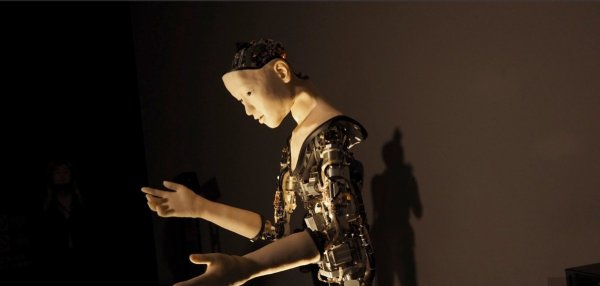
What if the line between human and machine isn't a line at all, but a shared, evolving space? That's the central question driving a new interdisciplinary research initiative at the University of Edinburgh. The Anthrobotics Cluster, founded by philosopher and novelist Luis de Miranda, is challenging conventional thinking about robots, humans, and the intelligent systems that increasingly mediate our lives.
The term 'anthrobot' itself isn't new. Roboticist Mark Rosheim introduced it years ago as a technical label for anthropomorphic devices like robotic prostheses. But de Miranda and his colleagues are expanding that definition significantly. They propose viewing a robot not just as a physical machine, but as an 'algorithmic enabler'—a concept that captures both the helpful and potentially harmful roles these systems can play.
This dual nature is key. An algorithmic enabler can ease physical or mental tasks, but it can also foster unhealthy dependency. De Miranda argues that this bivalence mirrors public ambivalence toward machines, making the definition a useful ethical lens for evaluating technology's impact.
Building on this, the team reimagines the anthrobot as a 'human collective hybrid system made of flesh and protocols.' Institutions, corporations, even nation-states, they argue, function as collective anthrobots—coordination artifacts that shape our behavior and social reality. This perspective shifts focus from individual users to the organized collectives that define our interactions with technology.
From Philosophy to Practical Research
The Anthrobotics Cluster emerged from de Miranda's earlier work, including his 2014 creation of the CRAG Research Group at Edinburgh, dedicated to exploring the 'creation of reality.' A 2015 conference on the same theme, which brought together AI specialist Alan Bundy and social anthropologist Tim Ingold, provided the spark. The term 'anthrobotics' came to de Miranda during those exchanges, and the Cluster was formally established shortly after.
Collaboration is central to the initiative. De Miranda is working with informatics researchers Michael Rovatsos and Ram Ramamoorthy, and the first academic paper on anthrobotics was presented at the Robophilosophy Conference 2016 at the University of Aarhus. Funding from the University of Edinburgh has supported workshops and reading groups, and a planned international workshop in March 2017 will involve the Human Centred Computing Group at the University of Oxford, where de Miranda has begun collaborating with Professor Marina Jirotka and her team.
De Miranda's own research trajectory includes a PhD thesis on the concept of 'esprit de corps' and a forthcoming fellowship application to Oxford's Department of Computer Science, focusing on 'information as worldforming.' He sees anthrobotics as a 'working hypothesis towards an interdisciplinary science of world-forming,' one that draws on philosophy, computer science, anthropology, and psychology.
Why This Matters for Our Technological Future
As artificial intelligence and robotics advance at a rapid pace, the need for a nuanced understanding of human-machine relations becomes more pressing. The anthrobotics framework offers a way to move beyond simplistic narratives of either technological utopia or dystopia. By recognizing that humans have always been 'technotenic animals'—with a deep-seated desire for technology—the research encourages a more thoughtful approach to designing systems that align with human values.
De Miranda's vision is ultimately political as well as philosophical. He calls for 'more democratic technological and scientific empowerment,' urging people to become active co-creators of their technological environments rather than passive adapters. In this view, understanding our anthrobotic condition is the first step toward shaping a future where technology serves a plurality of human needs and aspirations.






Comments
Sign in to leave a comment
No account? Create one
No comments yet.