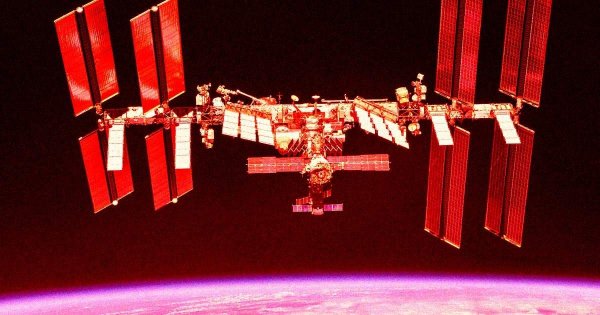
NASA is moving forward with plans to lower the orbit of the International Space Station (ISS) beginning around 2030, ultimately allowing the 450-ton structure to burn up in Earth's atmosphere and crash into the ocean. While the agency describes the deorbit as low risk, a growing number of researchers are raising concerns about the environmental toll such a massive reentry could take on the upper atmosphere.
According to a report by Space.com, the incineration of the ISS — the largest human-made object ever to orbit Earth — could release harmful chemicals that may damage the planet's protective ozone layer. Leonard Schulz, a researcher at Technische Universität Braunschweig, noted that the station's mass alone is striking: it equals half of all human-made reentry mass recorded in 2019 and a third of that in 2023. "Considering its large mass ... it only enhances the atmosphere problem induced by reentry," Schulz told Space.com. He added that future studies will likely examine what substances this reentry releases into the atmosphere.
The concern is not hypothetical. Earlier this year, a study published in the journal Geophysical Research Letters found that when satellites like SpaceX's Starlink constellation burn up during reentry, they can inject aluminum oxides into the upper atmosphere. The authors calculated that a 550-pound satellite produces roughly 66 pounds of aluminum oxide nanoparticles, which can take up to 30 years to drift down into the stratosphere. With the number of satellites in low-Earth orbit growing rapidly, the cumulative effect could lead to "significant ozone depletion," according to the paper.
Given the ISS's enormous mass, the potential environmental impact is considerable, though researchers are still assessing the full scope of the risks. NASA has selected SpaceX to build a "US Deorbit Vehicle," a modified Dragon cargo spacecraft, to guide the station out of orbit. The process will take several years, giving NASA some control over where debris lands. While no official landing site has been announced, the most likely target is the center of the South Pacific Ocean, the most remote point on Earth.
Ocean Impact Minimal, Atmosphere at Risk
Luciano Anselmo, a physicist at the Space Flight Dynamics Laboratory, told Space.com that the ocean impact will likely be negligible. He pointed out that all human-made debris that has fallen from orbit since the start of space activity has a combined mass smaller than a single sunken World War II battleship. "Negligible compared to the mass of all the ships and cargo sunk every year, not to mention all other forms of marine waste dumping and pollution," Anselmo said.
However, Anselmo emphasized that the same cannot be said for the upper atmosphere. "The impact of space launches and reentries is probably becoming significant, and whose possible consequences are not yet fully assessed," he added. This uncertainty underscores the need for further research as the ISS deorbit approaches.
The deorbit of the ISS marks a significant milestone in space operations, but it also highlights the growing challenge of managing the environmental footprint of human activity in orbit. As more satellites and spacecraft are launched, the cumulative effects on the atmosphere may demand closer scrutiny.







Comments
Sign in to leave a comment
No account? Create one
No comments yet.