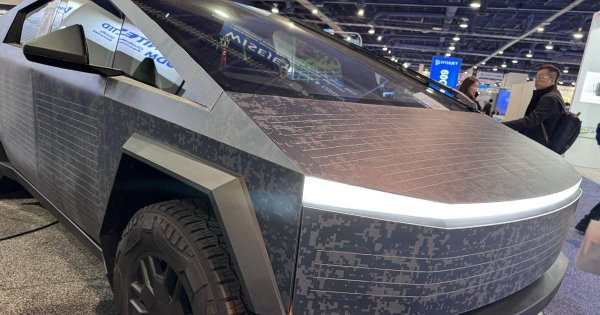
At the 2024 Consumer Electronics Show, a California-based company called Sunflare unveiled a solar wrap designed for the Tesla Cybertruck, promising to convert the electric pickup's exterior into a power-generating surface. The wrap, which uses copper indium gallium selenide (CIGS) solar cells, is priced at $10,000 and includes a 5 kW battery inverter, according to the YouTube channel “Electric Revolution,” which spoke with company representatives at the event.
While Tesla CEO Elon Musk has long talked about integrating solar panels into the Cybertruck, the company has yet to offer such an option. In 2019, when the Cybertruck was first announced, Musk claimed that solar cells on the truck's bed could add 15 miles of range per day, with extendable “fold out wings” potentially adding more. However, that concept never materialized, leaving third-party companies like Sunflare to step in.
Potential Range Gains
The exact range increase from the solar wrap remains unclear. Under ideal conditions, it might add anywhere from 12 to 18 miles of range per day, based on back-of-the-envelope calculations by Torque News, which noted that these figures are likely generous. This is modest compared to the Cybertruck's real-world range of around 230 miles on a single charge, which is below average for the EV market.
For context, other solar charging solutions, such as the panels on the Toyota Prius Prime, offer only a few miles of range per day, and only after hours of direct sunlight. The Sunflare wrap, if it becomes a real product rather than vaporware, could be useful in specific scenarios like off-grid camping, where a steady source of renewable energy is valuable.
Sunflare has also been developing off-grid power solutions for campers and camper vans, suggesting the company has experience in portable solar applications.
Impact on Vampire Drain
One potential benefit of the solar wrap is slowing the rate of “vampire drain,” the phenomenon where EV batteries lose charge over time when not in use. Some Cybertruck owners have reported this issue, and the solar wrap could help mitigate it, though it won't dramatically extend the vehicle's range.
The Cybertruck, a 6,600-pound stainless steel vehicle, has faced criticism for its below-average real-world range, which puts it behind competitors. While the solar wrap concept is elegant, adding a handful of miles per day won't change the overall efficiency equation. Still, for adventurous drivers and overlanders, access to free renewable energy can be a practical advantage.
As Tesla shifts its focus away from Cybertruck production due to slumping demand, third-party innovations like Sunflare's solar wrap may offer a glimpse into the future of EV accessories, even if the immediate impact on range is limited.







Comments
Sign in to leave a comment
No account? Create one
No comments yet.