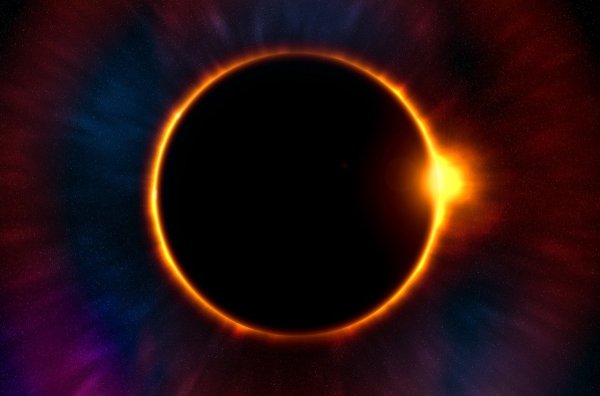
The Moon's steady retreat from Earth is setting the stage for the eventual disappearance of total solar eclipses, a celestial spectacle that has fascinated humanity for millennia. Scientists calculate that in about 620 million years, the Moon will be too far away to completely block the Sun, making total eclipses a thing of the past.
This slow-motion transformation stems from the Moon moving away from our planet at a rate of 3.8 centimeters (1.5 inches) per year. As the distance grows, total eclipses will give way to annular eclipses, where a bright "ring of fire" remains visible around the Moon's silhouette. While that shift may seem distant, the next total solar eclipse—visible across the United States on August 21—offers a timely reminder to witness the cosmic alignment while it lasts.
A Discovery Rooted in History
The understanding of this gradual change traces back to Edmond Halley in 1695. He noticed that recorded eclipse dates from ancient Greece and Rome did not match the calendar dates expected at the time. Trusting Isaac Newton's theory of universal gravitation, Halley concluded that Earth's rotation was slowing, making days longer.
His hypothesis was later confirmed using laser instruments left on the Moon by Apollo astronauts. These measurements revealed that tidal forces—caused by the friction of shallow continental shelves against high tides—are gradually decelerating Earth's spin. To conserve angular momentum in the Earth-Moon system, the Moon gains energy and moves farther away.
As the Moon's orbit expands, its apparent size in the sky shrinks. Eventually, it will no longer be large enough to cover the Sun entirely, ending total eclipses. The exact timeline remains uncertain, but the projected cutoff is around 620 million years from now—long after humans may have migrated to other planets.
Why This Matters
This celestial shift is more than a curiosity; it highlights the interconnectedness of planetary forces. The same tidal interactions that slow Earth's rotation also influence the Moon's orbit, demonstrating how small changes accumulate over eons. For astronomers, the study of eclipses has provided a window into the mechanics of our solar system, building on centuries of observation and theory.
Looking ahead, scientists are applying similar long-term perspectives to other cosmic questions. Missions like NASA's Mars Atmosphere and Volatile Evolution (MAVEN) have shown how solar wind stripped Mars' atmosphere, but fully understanding such processes may require generations of data collection.
As the August 21 eclipse approaches, it serves as a reminder that our view of the universe is always evolving. While the end of total eclipses is inevitable, the opportunity to experience one remains a rare and fleeting gift.






Comments
Sign in to leave a comment
No account? Create one
No comments yet.