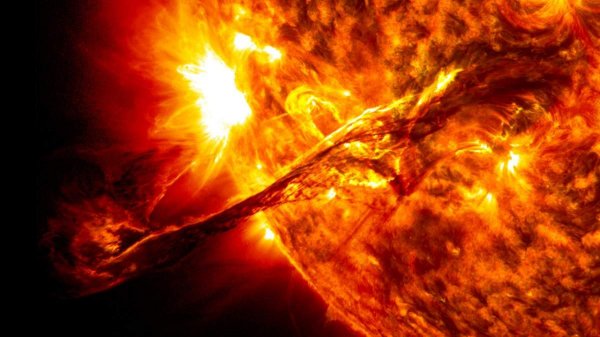
Solar eruptions—both the small bursts of plasma known as coronal jets and the massive clouds of magnetized gas called coronal mass ejections (CMEs)—have long puzzled astrophysicists. Now, a collaborative study from Durham University in the UK and NASA's Goddard Space Flight Center offers a theoretical framework that could explain both phenomena under a single mechanism.
The research, published in the journal Nature, proposes that these eruptions originate when magnetic field lines on the sun's surface break apart and reconnect above the jets. This process, dubbed the "breakout model," was previously thought to require different drivers for different scales of eruptions. The new model suggests a common underlying cause, which could simplify how scientists understand solar activity.
Lead researcher Peter Wyper of Durham University said in a press release: "It was previously thought that there were different drivers for the varying scales of eruptions from the Sun, but our research provides a theoretical universal model for this activity, which is very exciting."
Potential for Better Space Weather Prediction
The breakout model could have practical implications for predicting solar flares. Wyper noted, "A greater understanding of solar eruptions at all scales could ultimately help in better predicting the Sun's activity." If the model is confirmed, it might allow forecasters to anticipate when CMEs are likely to occur, giving more warning time for protective measures.
Large-scale CMEs are of particular concern because they can disrupt radio transmissions and satellite communications by emitting intense electromagnetic radiation. They also trigger aurorae near Earth's poles. The most powerful recorded event of this kind occurred in 1859, known as the Carrington Event, which caused widespread telegraph failures. A similar event today could pose risks to astronauts in space and to modern infrastructure.
The next step, according to the researchers, is to validate the breakout model using high-resolution observations of the solar atmosphere. Richard DeVore, a researcher at NASA's Goddard Space Flight Center, said, "Within a unified context, we can advance understanding of how these eruptions are started, how to predict them, and how to better understand their consequences."
While the model is still theoretical, its potential to unify explanations for solar eruptions marks a step forward in solar physics. If confirmed, it could enhance our ability to prepare for space weather events that affect both technology and human activity beyond Earth.





Comments
Sign in to leave a comment
No account? Create one
No comments yet.