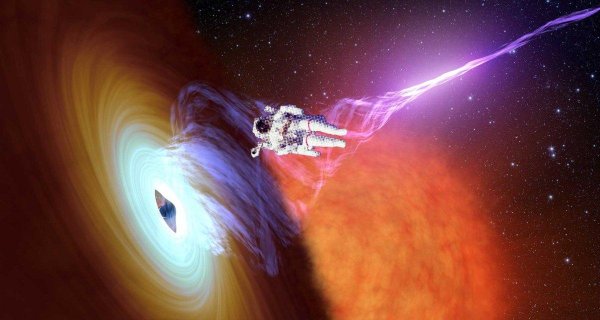
For most people, falling into a black hole is the stuff of science fiction—a one-way ticket to oblivion. But a new study from the University of California, Berkeley, suggests that, under specific conditions, a traveler might actually make it through to the other side. The research, led by physicist Peter Hintz and published in the journal Physical Review Letters, reconsiders what happens at the inner boundary of a black hole, known as the Cauchy horizon.
The study focuses on black holes that carry an electromagnetic charge—a type that remains purely theoretical, as no such object has been observed. All black holes possess an event horizon, the point of no return. But for a charged black hole, crossing that threshold leads not to an immediate end, but to a second boundary: the Cauchy horizon. Beyond that, the known laws of physics break down, and predictions become impossible.
“Given that we don’t know what happens past the Cauchy horizon, it could be crazy things as long as they’re mathematically possible,” Hintz told New Scientist. That uncertainty includes the possibility of encountering anything from radiation to, as Hintz whimsically put it, elephants hurtling at warp speed.
Yet the team’s calculations offer a glimmer of hope. Because the universe is expanding, energy distribution may be more uniform than previously assumed. Under that premise, a spaceship accelerating sufficiently fast might cross the Cauchy horizon before the extreme gravitational forces take their toll. The math, however, only works for electrically charged black holes, which remain hypothetical.
Still, the findings have broader implications. The behavior of charged black holes could mirror that of rotating black holes, which are known to exist. Rotating black holes, like their charged counterparts, have a similar inner structure, and studying the theoretical case could shed light on real cosmic phenomena.
Why the Cauchy Horizon Matters
At the Cauchy horizon, the deterministic principles that govern our everyday world—cause and effect, predictability—fail. On Earth, we rely on past events to forecast the future. But at this cosmic boundary, the laws of physics no longer apply, meaning anything could emerge from the singularity. This breakdown of predictability is not just a philosophical puzzle; it challenges the very foundation of scientific inquiry.
Hintz’s study, while focused on a hypothetical scenario, underscores the value of thought experiments in theoretical physics. They allow scientists to probe the limits of our understanding and imagine possibilities that, while not immediately practical, expand the realm of what might be.
If a traveler did survive the crossing, what awaits on the other side remains unknown. The study speculates that the cosmic landscape could be filled with wormholes, offering a potential exit to another universe—perhaps one with fewer unexpected projectiles.
For now, the prospect of surviving a black hole remains a theoretical curiosity. But as Hintz’s work shows, the universe’s strangest phenomena often yield insights that reach far beyond the initial question.






Comments
Sign in to leave a comment
No account? Create one
No comments yet.