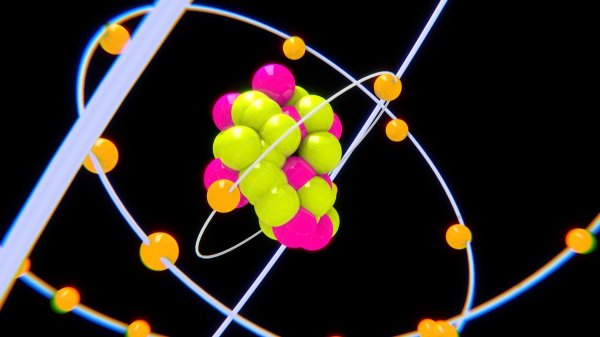
An international collaboration has reported the most precise determination yet of the proton's magnetic moment, a fundamental property that underpins the structure of atoms. The new value, 2.79284734462 nuclear magnetons with an uncertainty of just 0.00000000082, represents a precision better than one part per billion, according to the team's findings.
The work, led by scientists from RIKEN's Ulmer Fundamental Symmetries Laboratory (FSL) in Japan, Johannes Gutenberg-Universität Mainz, the Max Planck Institute for Nuclear Physics in Heidelberg, and GSI Darmstadt in Germany, pushes the boundaries of what can be measured about the proton's inner workings.
The magnetic moment is a particle-level property that gives rise to magnetism. For the proton, it is a key parameter in quantum electrodynamics and helps describe how the particle interacts with magnetic fields. A more exact value allows physicists to test theoretical predictions with greater rigor.
To achieve this level of precision, the researchers had to isolate a single proton—not a cluster or a beam, but one individual particle. They used a Penning trap, a device that confines charged particles using electric and magnetic fields. The team first detected the thermal signal of ions, then applied an electric field to strip away all but one proton.
The experiment required moving the proton between two different traps. In the first trap, the proton's spin synchronized with the magnetic field, and the scientists measured two frequencies: the cyclotron frequency (the proton's circular motion in the magnetic field) and the Larmor frequency (the spin precession). These two values, combined, yield the magnetic moment. The proton was then shuttled to a second trap, where a magnetic bottle allowed the team to read out its spin state.
Georg Schneider, the study's first author, said the work will “allow us to get a better understanding of, for example, atomic structure.” The precision achieved is not just a technical feat; it offers a sharper lens for examining the fundamental forces that shape matter.
Why This Measurement Matters
Beyond refining our picture of the proton, the technique opens a new window for antimatter research. Andreas Mooser, a member of RIKEN FSL and second author of the study, noted that the same method could be applied to measure the antiproton's magnetic moment at the BASE experiment at CERN. Comparing the two values could reveal subtle differences that might explain why the universe is dominated by matter and not antimatter.
The new result is a stepping stone for future experiments that aim to test the symmetries of nature. If any discrepancy appears between proton and antiproton measurements, it could point to physics beyond the Standard Model.
The team's achievement demonstrates how precise control over a single particle can yield insights into the building blocks of reality. With the technique now proven, the next steps involve applying it to antiprotons, a challenge that could take years but holds the promise of answering one of cosmology's deepest questions.








Comments
Sign in to leave a comment
No account? Create one
No comments yet.